



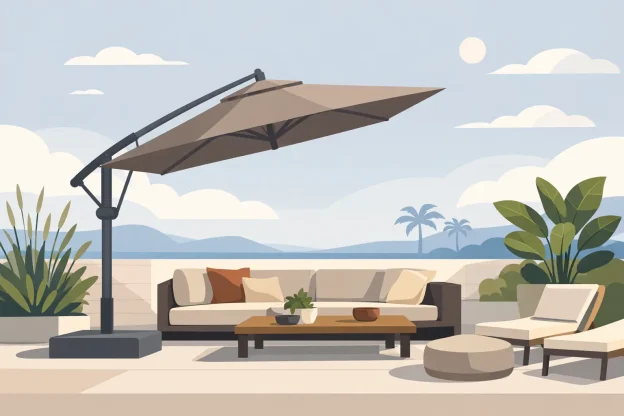
A cantilever umbrella can make a seating area feel like an outdoor room – provided its canopy reaches the right places and its structure is equipped for the conditions. For homeowners considering how to choose cantilever umbrella coverage for a Toronto patio, poolside or cottage deck, the decision is less about selecting a colour first and more about planning shade, clearance, wind exposure and everyday use.
Unlike a centre-pole umbrella, a cantilever model suspends the canopy from a side-mounted arm. That leaves the space beneath it open for a dining table, sectional, chaise loungers or a conversation set. It also means the umbrella needs a properly sized base and enough room behind or beside the furniture for the mast and swing of the canopy.
Start with the area you actually want to shade
The most common mistake is choosing a canopy based on the overall patio size instead of the usable seating zone. Measure the footprint of the furniture arrangement, then consider where people sit at different times of day. A canopy that looks generous over an empty deck can leave the outer seat of a sectional in full afternoon sun.
For a square dining set or compact lounge arrangement, a square or octagonal canopy often provides an efficient, balanced shade pattern. Rectangular cantilever umbrellas are especially useful over long dining tables, paired chaise loungers and linear sectionals. Their shape can follow the furniture layout more closely, reducing the amount of canopy extending into walkways or garden beds.
Allow for movement, too. Most premium cantilevers rotate, tilt or glide through multiple positions. The canopy’s full sweep may require more clearance than its closed position suggests. On a narrow condo terrace, an umbrella that rotates 360 degrees may be unnecessary if the railing, wall or neighbouring furniture limits its travel. In that setting, a more compact model with the right directional tilt can be the better investment.
Consider sun direction, not just noon shade
Midday is only part of the story. On west-facing GTA patios, late-afternoon sun is often the reason clients seek shade in the first place. A cantilever with multi-position tilt can lower the canopy toward a low sun angle without moving the entire base. At a cottage, where the sun may travel across an open shoreline or exposed lawn, a rotating canopy lets you adjust shade as the day changes.
If you want consistent coverage over a large dining and lounging zone, one oversized umbrella is not always the best answer. Two smaller cantilevers can offer more flexible shade, create a more considered visual rhythm and reduce the need for an exceptionally large, heavy base. The right approach depends on the furniture plan, circulation and how often the space is used for entertaining.
Choose the cantilever umbrella base before the canopy colour
A cantilever umbrella is only as dependable as its anchoring system. Its off-centre design creates leverage, so it requires considerably more counterweight than a centre-pole market umbrella. The required weight is determined by canopy size, arm construction and manufacturer specifications. It should never be estimated by appearance alone.
Many premium models use purpose-built base frames that accept multiple weight plates. Depending on the umbrella, these may be concrete, granite or resin-filled components. Other installations can be permanently anchored to a deck, patio slab or engineered footing. A fixed mount can produce a cleaner look and preserve floor space, but it needs careful planning before installation and may not suit every condominium, rooftop or rental property.
Wind deserves a straightforward conversation. No freestanding cantilever umbrella is intended to remain open in strong winds, even when it has a substantial base. A heavier base improves stability during normal use; it does not turn the umbrella into a permanent all-weather structure. If your property is exposed to lake breezes, a ravine, open golf course or waterfront conditions, selecting a model built for wind management and committing to closing it when unattended are equally important.
For condo owners, review building rules before ordering. Some buildings restrict the placement of weighted bases, require clearance from railings or set limits on objects extending beyond a balcony. Confirming these details early protects both the investment and the ordering timeline.
Look closely at the frame, canopy and operating system
Premium cantilevers are designed for years of seasonal use, but material quality affects how they look and operate over time. Powder-coated aluminum frames are popular because they resist corrosion, offer a clean architectural finish and are relatively easy to maintain. Stainless steel components can add strength in key areas, although coastal or highly exposed environments still benefit from regular cleaning and inspection.
The canopy fabric influences shade quality, colour retention and long-term appearance. Solution-dyed acrylic is widely valued for its rich colour, resistance to fading and soft textile feel. Higher-quality outdoor fabrics are also easier to maintain when spills, pollen and city dust accumulate. Fabric colour is not only an aesthetic decision: darker canopies can create a more intimate shade, while lighter tones may brighten the seating area beneath them. Both can work beautifully when coordinated with the frame, cushions, decking and exterior finishes.
Pay attention to the mechanics you will use every week. A crank lift is familiar and straightforward, while a pulley, sliding handle or assisted opening system may feel more natural on larger models. Rotation should lock securely at the desired angle. Tilt controls should be accessible without requiring you to stretch across a table or move furniture. If more than one member of the household will operate the umbrella, ease of use matters as much as the specification sheet.
Ventilation and canopy shape affect comfort
A vented canopy allows air to pass through the top, helping reduce uplift in light breezes and improving comfort underneath. This is a worthwhile feature, particularly on open patios. It does not eliminate the need to close the umbrella when wind increases, but it can make the canopy feel less reactive during ordinary summer conditions.
The canopy profile also changes the look of the space. A clean, modern square canopy can suit contemporary composite decking and low-profile sectionals. A softer octagonal form may complement traditional brick, stone gardens or cottage settings. Rather than choosing in isolation, view frame finishes and fabric samples against the materials already present outdoors.
Plan for storage, service and the Canadian season
A cantilever umbrella should be closed whenever it is not being actively enjoyed and always before wind or storms arrive. A fitted protective cover helps keep the canopy and frame clean during the season, particularly under trees or near construction dust. It also makes the patio feel more orderly when the umbrella is not in use.
For winter, follow the manufacturer’s storage guidance. In many cases, removing the canopy or storing the closed umbrella under its cover in a protected location will extend fabric life and reduce unnecessary exposure to snow, ice and freeze-thaw cycles. A base may remain in place if it is designed for outdoor use, but its condition and drainage should be checked each spring.
Serviceability is another reason to choose carefully. Replacement canopies, covers, handles and base components may be available for established premium manufacturers, but availability varies by model and finish. A well-supported product can be refreshed over time instead of replaced when a single component wears out.
Match the umbrella to the way you entertain
A family that hosts long summer dinners may prioritize broad rectangular shade over a dining table. A poolside setting may benefit from a rotating canopy that follows loungers through the afternoon. For a quiet urban terrace, the priorities might be compact proportions, a refined frame finish and an operating system that is simple to manage in close quarters.
This is where a consultation can save time. At Deck, Home & Patio, the most useful starting point is often a furniture layout, a few measurements, photographs of the space and an honest discussion about sun and wind. From there, canopy shape, frame finish, fabric, base configuration and placement can be considered together rather than as separate purchases.
The best cantilever umbrella should feel effortless once it is installed: shade where you want it, a base that inspires confidence, and a design that belongs with the rest of your outdoor space. Taking the time to plan those details now leaves more time to enjoy the patio when the weather is finally right.