



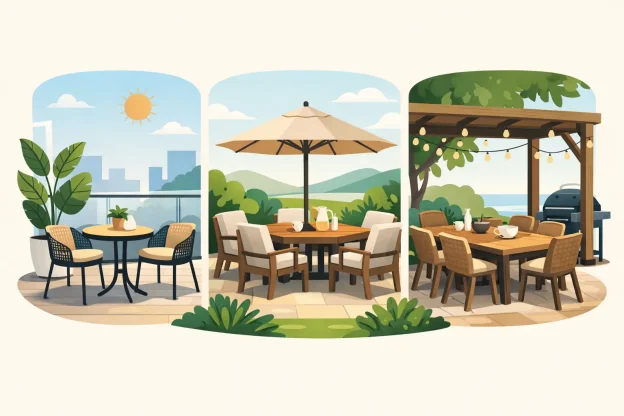
The right outdoor dining sets do more than provide a place to eat. They set the pace for summer breakfasts on a Toronto deck, long cottage dinners, poolside lunches and the kind of relaxed entertaining that keeps guests outdoors long after dessert. Choosing well means looking beyond the table-and-chairs photograph and considering how the furniture will feel, fit and perform in your particular space.
A premium dining set is a considered purchase. Its frame, tabletop, chair construction, cushion fabric and proportions all affect how confidently it will serve your household over many seasons. The most successful choice starts with how you actually live outside, then brings material, style and scale into alignment.
Start With the Way You Host
Before selecting a shape or finish, think about the gatherings the space needs to support. A couple who enjoys morning coffee and occasional guests has different requirements than a family that hosts Sunday lunches for eight. The same is true for a condo terrace used by two people most days but expected to accommodate friends a few times each season.
Ask whether dining is the patio’s primary purpose or one part of a larger outdoor room. If the area also needs lounge seating, a fire table, planters or a grilling zone, the dining footprint should leave room for people to move easily. A handsome table that narrows the only passage to the house will quickly feel less useful.
For regular entertaining, it is often wiser to choose a table that comfortably seats your normal group and extends when needed. Extension tables offer practical flexibility, though they do add mechanical components and may require more storage space for leaves. A fixed table can be the more elegant, uncomplicated choice where the guest count is consistent.
Size Outdoor Dining Sets for Comfortable Movement
The table dimensions are only part of the equation. Chairs need room to pull back, guests need a clear route around the table, and servers need enough space to move without asking everyone to stand up. As a general planning guideline, allow about 90 cm between the table edge and a wall, railing or planter where possible. More space is preferable on a busy entertaining patio.
Round tables encourage conversation and work beautifully in compact or square spaces because there are no corners to navigate. They are especially effective for four to six guests. Rectangular tables suit long decks and larger patios, naturally defining a dining zone while accommodating six, eight or more diners. Oval tables soften the look of a rectangle and can improve circulation at each end.
Chair width deserves attention as well. Generously scaled dining chairs with arms offer a more relaxed, linger-worthy experience, but they occupy considerably more room than slim side chairs. For a narrow balcony or urban terrace, refined armless chairs may make better use of the available area. If comfort is a priority, a combination of armchairs at the heads of a table and side chairs along the length can balance presence and capacity.
Measure the Space You Can Use
Measure finished, usable space rather than the overall deck or patio dimension. Account for steps, doors that swing outward, railings, pool access, outdoor kitchens and the path to the barbecue. On an upper-level deck or balcony, also consider delivery access, elevator dimensions and building rules before finalizing a substantial table.
A simple taped outline on the ground can be revealing. It lets you test not just where the table will sit, but where chairs will be when occupied. This step is particularly valuable when ordering custom furniture, where the ideal configuration is available but returns are not a practical substitute for proper planning.
Choose Materials for Canadian Conditions
Toronto summers can be humid and hot, while shoulder seasons bring rain, wind and pronounced temperature changes. At a cottage, exposure may be even more demanding, with stronger sun, lake moisture or limited winter storage. Material selection should reflect those realities as much as the look you want.
Powder-coated aluminum is a leading choice for many outdoor dining settings. It is relatively lightweight, corrosion-resistant and available in an extensive range of frame finishes. Quality matters here: a well-built frame and durable finish will stand up far better over time than a lightweight, thinly coated alternative. Aluminum also works well with sling seating, cushions, woven details or ceramic-style tabletops.
Teak brings natural warmth and exceptional outdoor credentials. Left untreated, it develops a soft silver-grey patina; maintained regularly, it can retain more of its original golden tone. Neither approach is wrong, but it helps to decide which appearance you prefer before buying. Teak is substantial and timeless, although it generally requires a greater initial investment and occasional care if you want a more uniform finish.
Wrought iron and cast aluminum can provide a more traditional or architectural look. They have visual weight, which is useful in exposed areas, but heavier pieces require thoughtful placement and may be less convenient to move. Stainless steel, marine-grade hardware and carefully engineered composite materials can also be excellent choices, particularly where contemporary design and low maintenance are priorities.
For tabletops, consider heat, weight and daily use. Glass can feel light and polished but needs regular cleaning. Porcelain and ceramic-style surfaces offer a refined, durable finish and often handle everyday dining beautifully. Stone tops make a strong design statement, although their weight may affect rooftop, balcony or deck considerations. Slatted aluminum and teak tops are classic, practical options with their own distinct character.
Comfort Is What Makes the Set Get Used
A dining chair can look excellent and still discourage a second cup of coffee. Seat depth, back angle, arm height and cushion support all matter, especially for meals that turn into evenings. Whenever possible, sit in comparable pieces and give yourself time to assess the experience rather than making a decision based on appearance alone.
Sling chairs are supportive, quick-drying and straightforward to maintain. They are well suited to pool areas, uncovered patios and households that favour a clean-lined look. Cushioned dining chairs introduce a more residential, tailored feel and can make an outdoor dining area feel as inviting as an interior room. The trade-off is that cushions need appropriate fabric selection, seasonal care and dry storage during the off-season.
Premium outdoor fabrics are designed to resist fading and manage moisture, but no fabric is entirely maintenance-free. Light colours can be beautifully fresh in a shaded setting, while darker or textured fabrics may be more forgiving around children, pets and frequent meals. A knowledgeable retailer can help coordinate fabrics with frame finishes and nearby lounge furniture without making the full space feel overly matched.
Build a Cohesive Patio, Not a Matching Catalogue Page
Outdoor furniture does not need to come from one collection to feel intentional. In fact, mixing complementary materials can give a deck or garden a more personal, established appearance. A teak dining table may pair well with tailored aluminum chairs. A dark metal frame can anchor pale cushions, stone pavers and warm wood accents.
The key is to repeat a few visual cues: perhaps the same warm metal tone, a shared fabric family or a consistent level of formality. Consider the view from inside too. Large patio doors often make the outdoor dining area part of the home’s interior sightline, so the furniture should feel connected to adjacent rooms rather than like an afterthought.
Umbrellas and shade structures deserve early consideration. A centre-pole umbrella requires a compatible table opening and adequate base weight. A cantilever umbrella can create flexible shade without interrupting the tabletop, but its footprint and rotation clearance must be planned carefully. If dining will happen regularly in strong sun, shade is not an accessory – it is part of the comfort plan.
Custom Ordering Rewards Careful Decisions
Custom-order outdoor furniture opens up far more than a floor display can show. Frame colours, fabrics, table sizes, cushion details and seating configurations can be selected for the project instead of accepted as a compromise. That freedom is valuable, but it also makes early planning important, especially when furnishing for a specific season or event.
Review lead times before committing to a timeline, and confirm every practical detail in the quotation: quantities, finishes, fabrics, delivery access and any assembly requirements. For hospitality spaces, commercial-grade construction, stackability, cleanability and replacement availability may matter as much as appearance. A restaurant terrace has different demands than a private garden, even when the design brief looks similar.
At Deck, Home & Patio, the consultation process is designed to make those decisions clearer. Comparing materials, samples and configurations with a furniture specialist can prevent expensive sizing errors and help you identify the dining set that genuinely suits the property, not simply the one that looked best online.
The best outdoor dining area feels easy once it is in place: enough room to pull up a chair, enough comfort to stay awhile, and materials chosen with confidence for the seasons ahead. Start with your space and your habits, then let the furniture earn its place at every meal.